

If you’re not vibe-coding, and you don’t have someone in your business who is, I think you should be worried.
Last month, Peter Lohmann hosted a guest article in his newsletter from Jan Leasure, a fantastic PM out of Monterey, CA. Jan runs a great business, and she’s done some creative things over the years to get more revenue out of her business in the PM-hostile territory of California. But I did disagree a great deal with her guest article, so I wanted to make sure we cover that here, as I know a lot of our readers are also readers of Peter’s publication.
As you know, I’m always the first person to say that panic is neither a tactic nor a strategy. So I definitely agree with the author that you shouldn’t be panicking if you’re not vibe-coding yet. But where I think her argument really falls apart is the “I’ve seen this before” framing and comparing the current AI situation to prior technological transitions in our industry. AI is not comparable to moving from typewriters to PCs. AI is comparable to our ancestors discovering fire. In other words, it is a complete and utter groundshift that will change everything, not only in our business, but in every business and in every other aspect of society.
My Concern
My main concern with the article is that I think it’s quite effective. Jan is a good writer, and she’s presented her case well. I think a lot of PMs out there likely read it and suddenly felt calm about something that they had been worried about. But that’s the whole trap here. Comforting advice that’s wrong doesn’t feel wrong until another 18 months have passed and now you’re way behind and can’t catch up.
So I don’t want you to panic, but I do want you to be cognizant of the risks and the very real concerns here. To stick with my discovery of fire analogy, if you were a hominid about one million years ago on the African savannah, and you looked across to the next tribe’s encampment and saw them sitting around a controlled fire, you’d probably be impressed and wish that you had that power, but you’d probably also think that you’d survived all this time without it, so you’ll probably be just fine. But the history of evolution shows otherwise. When one group gets that kind of advantage over a competing group, the group with the advantage is the one likely to survive and pass on their genes while the competing group is likely to die out. The same is true in business. If your competitors have found a significant and substantial advantage, it is likely that they will use that advantageous to undercut your pricing, provide better service, etc. and steal your market share. It may not happen immediately. But over time it will, and if you aren’t being careful, it may be too late by the time you realize that it’s happening.
I don’t want you to find yourself looking over at your competition and seeing them with a fire going while you’re still eating raw meat and struggling to stay warm. So while the author’s article might have made you feel better, I’m here to snap you out of it. For your own good.
This Isn’t Typewriter vs. PC
First, let’s zoom in on why I think this is more discovery of fire and less computer word processor. It took about fifteen years for a computer to become a necessity in a PM office (or most other offices, for that matter). While Altair and Apple were a little earlier to the game in the 1970s, these were mostly hobbyist computers. It wasn’t until 1981 when IBM released the PC 5150 that we had the first real general purpose computer that could have real world business applications. And yes, there were early adopters in the 80s long before it would become necessary to have a computer to compete. Throughout the 80s, and even into the early 90s, businesses continued to make do with old schools typewriters, carbon copy paper forms, etc. While a computer certainly made some things easier, there was no extreme advantage that someone with an IBM compatible PC could have over someone without. This was partially because the software just didn’t exist for individual business use cases, but it was also because the computers just weren’t all that feature-rich themselves yet. There was no internet available to the general public. Printers were slow, massive, and expensive. Monitors were tiny. It just wasn’t a big efficiency boost to use a computer.
This started to change by the late 90s. The internet still wasn’t ubiquitous, but it was relatively common. Computer costs had plummeted, making it possible to put one on every desk. Inkjet printers had arrived for a reasonable cost. But most importantly, software was showing up that provided specific business advantages. PROMAS was released for Windows PCs in 1995, and Tenant Pro was a notable competitor around the same time (my own PM company used Tenant Pro until 2012).
Note this time scale. First legit IBM PC released in 1981, and first dedicated PM software in 1995. That’s a decade and a half before the software even became available for PM applications after the hardware existed. But also pay attention to just how quickly PMs started implementing this software after that. PROMAS became widespread in the industry within just a few years. And if you were still using paper forms and manual ledgers by 2000, you were behind.
But still, that’s a time span measured in years, not months. It was a slow ramp. Now I want you to compare that to vibe-coding with AI. The term vibe-coding was first coined in February of last year. That’s right, just 18 months ago. By the end of the year, it was named “Word of the Year” by the Collins English Dictionary and had been incorporated into Merriam-Webster’s dictionary. While the term had just been invented in February, by March of the same year Y Combinator reported that a full 25% of its startup companies were operating on AI-generated codebases. By July, the Wall Street Journal was reporting that vibe-coding was being widely adopted by professional software engineers for commercial applications. By early this year, less than a year after the term had first been introduced to our language, leaders in the software engineering space, such as the original inventor of Linux, were using vibe-coding to develop significant software packages instead of writing the code themselves. And today, just 18 months from the origination of the term, the United States government is so concerned about the capabilities of Anthropic’s Mythos AI model that they ordered the company to not publicly release it and to instead allow only a small handful of very large companies have access so that they can use it to beef up their security before anyone else can use it to hack them. The government is basically worried that AI is so good at reading and writing code that the most secure computers on Earth can’t be protected from it.
Folks, this isn’t going from a typewriter to a PC. This is going from horse and buggy to flying car (something not even invented yet). So with all due respect to Jan, who has obviously been around the block a few times and seen a lot of technologies enter the scene over the course of her career, she’s simply never seen anything like this. None of us have, in any arena. This is a landmark event in the evolution of our entire species. The AI-dominated world we live in five years from now will be virtually indistinguishable from the world we lived in before vibe-coding was a word.
A Change in Category, Not Form
Jan tells the story of Windows retiring her DOS database and how this was actually a good thing, because new software (like PROMAS) arrived on the scene to do it better. She says that her “technical knowledge turned out to be incidental, not a requirement.” But what she’s missing there is who captured the value of that shift. The software vendors did. Her self-made database was effectively free, but with the release of PM-specific software, so began the age of her having to pay a portion of her revenue to PM software companies for the next few decades.
And that’s why this is so different. The person who gets to extract the value today isn’t some third-party software vendor. Sure, Anthropic and OpenAI get to make some money from the sale of tokens, but it’s miniscule by comparison. These software companies have had us bent over for years upon years now paying each of them a few dollars a door, and horizontal SaaS companies like Monday and Process Street have been charging us by the user. Month after month, year after year, our revenue gets sucked away and paid to someone else who develops software that is useful, yes, but still doesn’t operate the way that we want our businesses to operate. We are paying them for the displeasure of having to find a thousand workarounds.
The age of AI is a completely different shift. The competitor who vibe-codes isn’t just getting a better piece of software than you. They’re getting it for free. And the software works exactly how they want it to with no inefficient workarounds. This isn’t just a change in form. It’s an entirely new category of innovation.
The reason this is so different is that it creates a massive and very fast competitive advantage for whoever implements it. Imagine eliminating tens of thousands of dollars a year in software costs. Will the competitor use that savings to undercut your prices, or will they use it to beef up their staffing to provide a better customer service experience? Either way, they’re going to blow you out of the water, and fast. Imagine being able to manage 2,000 doors with only five employees and a bunch of AI agents. Meanwhile you have a staff of 40 humans to accomplish the same thing. I’m here to tell you, a scrappy underdog can be creative and find ways to compete against a tough competitor, but literally no one can compete when they’re staffing at a rate of eight times their competition. That simply can’t be overcome.
Jan talks about two groups back in the day when computers were entering the scene: the panickers and the people who ignored it all. She says that “funny enough, they were wrong in the same direction. They both thought the computer was asking them to become something they weren’t.” But while this is an elegant argument, it’s also wrong on its face. The panickers lost some sleep. But the outright deniers lost their businesses or spent a full decade struggling to catch back up. You know I don’t advocate for panicking, but if I have to pick between panicking and sitting on the sidelines pretending there isn’t a problem when there really is, I’ll go with panicking. Thankfully you don’t have to choose. You can just calmly and effectively implement AI instead.
Finally, I’ll point out some survivorship bias in the original article’s argument. Stories are always told by the survivors, not by the people who got crushed. Because the people who got crushed by the competition in 1995 are long gone, having moved on to completely different industries long before most of us ever collected our first rent check. They couldn’t keep up because they didn’t take it seriously, and as a result, they sold out or just shut down three decades ago. They aren’t around the conference circuit and they aren’t writing newsletter articles. They just got smashed like the proverbial cockroach. Don’t let that be you.
Vibe-Coding Without Vibe-Coding
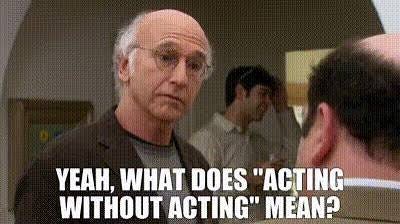
I’m a huge fan of “Curb Your Enthusiasm,” the comedy series created and starring Larry David, who was also the creator of “Seinfeld.” I remember an episode years ago where Larry had several of the “Seinfeld” stars make guest appearances as themselves on the series. In one scene, Jason Alexander, who played George on the original series, had written a book that he called “Acting Without Acting.”
Jason: “You don’t wanna see the actor at work. You wanna hide the technique. It’s acting. It’s doing the job. It’s the craft. So you hide the actor’s effort.”
Larry: “But that’s still acting.”
Jason: “Yeah, of course you’re acting.”
Larry: “So it could be ‘Acting with Acting’. That could be a title too.”
Jason (looking dejected): “Yeah.”
I bring this up because Jan is basically vibe-coding without calling it vibe-coding. She talks about having built an executive assistant to help triage her email. This a fantastic use-case, but it also happens to be…vibe-coding.
I think this gets down to a fundamental lack of understanding of just what vibe-coding really is. People see guys like me and Wolfgang out here being the nerds that we are, and they assume that this is a highly technical thing that requires a lot of software engineering know-how. But nothing could be further from the truth. I’ll quote Jan again: “we didn’t have to understand how it worked under the hood, we had to understand what it was for.”
That is the single best argument for vibe-coding anyone has written this year. Jan is talking about software like PROMAS in this quote, but she could have just as easily been writing about vibe-coding. Because the whole point of vibe-coding is that you don’t have to be technically proficient. You don’t need to be a nerd like me. All you need to do is be able to type in something resembling a human language and roughly make sense about what you want the system to do. The AI takes care of the rest. “Understanding what it is for” is the whole ballgame in vibe-coding. I don’t know how to write code. I can vaguely understand how to read some of it, but I couldn’t write it if my life depended on it. That’s why I vibe-code. And it’s why Jan and everyone else can (and should) also.
What We Agree On
All that being said, I think Jan gets a hell of a lot right in the article also. First, she’s 100% right that curiosity will always beat technical skill. The property manager who knows how to write in JavaScript or Python isn’t the one who is going to come out on top here. Instead, the property manager who is just curious about what the capabilities of AI are and toys around with it to try new and innovative things will be the one who wins this game. The great thing about vibe-coding is that your technical know-how is almost incidental. What actually matters is just having good ideas and being willing to discover new things and play around with the endless possibilities that AI presents to us.
Jan is also right that you do not need to learn how to write a single line of code. That’s true whether you just decide to vibe-code a simple AI assistant, or if you decide to build an entire frontend from scratch for your entire company like I have. As of the date of this writing, I have written 2,264,339 lines of code. I’ve written in TypeScript, Java, Python, and assorted other languages. And you know what? I don’t know a damned thing about any of these programming languages. If you asked me to write a simple program in Java that did nothing but tell you the time, I couldn’t do it. I have absolutely no idea how. Yet my entire PM company now runs on software that I’ve built from scratch.
Jan is also right that panic does no one any good. Not only does panic not get you anywhere, but it also forces many people into a form of paralysis caused by anxiety. If you are feeling panicked by this new age of AI, I would encourage you to just buy a basic $60/mo Cursor subscription, and tell it in plain language something that you’d like to build. It can be something super simple like a custom form for owner onboarding documentation, or something more complicated like asking it to connect to your Rentvine system and create a whole dashboard for you. Your panic will quickly fade away as you watch the AI guide you through the development of the software in plain language, all without you having to know how any of it works. Because here’s the dirty little secret: not even the AI scientists know how AI works. I’m not joking. I’m being dead serious. No one on earth currently understands how AI works. The smartest minds at Anthropic only know how they train AI (it’s a process called gradient descent where the system just tries a bunch of things over and over again until it arrives at the right outcomes and then learns from it). But how does the AI think after it’s been trained? Literally no one on earth knows the answer to that question. It’s all a black box. But you know what? It does work. So you’re in no worse a position than the smartest software engineer at Anthropic. If you can type in a recognizable language, then you can build software just like they can. No panic necessary.
Final Thoughts
The best way to close this is to quote Jan again: “‘I don’t necessarily need to vibe code’ is true. ‘I don’t need to pay attention’ is not.”
Because “vibe-coding” is just a fancy term dreamed up by a software engineer for what basically amounts to just telling a computer what you want and then watching as it builds it. It’s not a special skill. It’s not a secret knowledge. Literally anyone on earth can do it. But if you’re sitting on the sidelines and not even paying attention, then your goose is already cooked. You just haven’t figured it out yet.
Jan also says “you’re not behind. You’re right on time.” I would modify this just slightly. “You’re not behind yet.” But the clock is ticking. “Right on time” is a current status, not a strategy. You need a strategy, before it’s too late. Because just like the PM company owner who watched his business fade away in the late 90s because he was too slow to adapt to computers, there is a deadline here. And that deadline is racing up on us a hell of a lot faster than it was back then. This is an extremely accelerated timetable because of the self-improving nature of AI. This is a technology that advances on an exponential scale. No need to panic. But there is definitely a need to take action.
So I’ll repeat my call to action: buy a basic level Cursor subscription and build something this coming week. I don’t care what you build. Anything at all. It can be for your business, or it can just be a fun little thing you build for yourself or your family. But just give it a try. I promise you that all of that intimidation you feel about the tech will quickly fade away and be replaced with absolute wonder at what you’re now capable of accomplishing.
Experienced PM Looking for Work
Northpoint has terminated and laid off a lot of employees over the last few months as they’ve lost thousands of doors. One such employee is Elizabeth Herz, who has over 20 years of experience in the third-party PM industry, handling everything from leasing to owner relations to commercial PM. I’ve attached her resume below for anyone who could use a solid industry veteran in your operation.

Open to Work
Are you an experienced PM industry employee looking for work? Or are you a PM company or vendor seeking the best talent? Send me your info and I’ll feature it here!
Each week we also feature a Remote Team Member available through VPM Solutions. See this week’s below! Click on the image to get more info:

Newsletter Stats
Here are our statistics for the last 30 days:
7,560 subscribers
68,745 impressions
36.3% open rate
Issue with the highest readership:
“PropertyManagement.com Listened, But Some Concerns Still Remain”
4,664 impressions
Looking for Advertisers!
We always have ad slots available for industry vendors. Sign up for an ad or ad package here. Pricing and ad details can also be found at that link. Questions about advertising? Email abio@propertymanagerassist.com or book a time here.
Debate Me
Disagree with my take here? Have a different perspective? There’s nothing I love more than a good debate or even just an intelligent conversation. If you’d like to jump on a podcast recording with me to discuss this topic, please let me know!
The views expressed in this publication are the views of the author only and not any advertisers, sponsors, partners, affiliates, or organizations that the author may be a member of.